If you’ve lived through a New Jersey winter, you already know the drill: the wind ramps up, the forecast gets dramatic, and suddenly a “coastal storm” turns into a full-blown Nor’easter. Between driving rain, freezing temperatures, and heavy snow buildup, these storms don’t just cause inconvenience—they can trigger major roof leaks, especially for homes with solar panels.
For NJ homeowners, the biggest risk isn’t always the storm itself. It’s what happens after the storm—when melting snow, ice dams, and trapped water find a path into your attic, ceilings, or walls.
Let’s break down how Nor’easters, snow load, and rooftop solar systems combine into a perfect storm for leak problems—and how to protect your home.
Why Nor’easters Are So Hard on NJ Roofs
A typical summer thunderstorm hits fast and leaves quickly. Nor’easters are different. They often bring:
- Hours or days of wind-driven rain
- Snow that piles up and doesn’t melt quickly
- Freezing and thawing cycles that create ice dams
- Gusts strong enough to lift shingles and loosen flashing
That extended exposure is exactly what creates leaks. Water doesn’t need a huge opening—it only needs a weak spot.
Snow Load: The Hidden Roof Stress NJ Homeowners Don’t Think About
Snow might look harmless sitting on a roof… until it isn’t.
Snow load problems typically lead to:
- Sagging roof decking
- Separated seams on flat roofs
- Shingle movement and lifted nail lines
- Stress around roof penetrations (vents, chimneys, skylights)
Now add solar panels to the equation and things get even more complicated.
Solar Panels and Roof Leaks: What Causes the Risk?
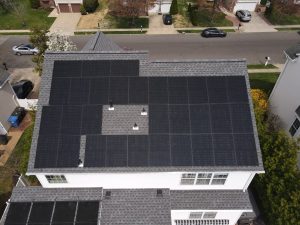
Solar itself isn’t the problem. In fact, a correctly installed solar array can perform perfectly for decades.
The leak risk comes down to one thing:
✅ Roof penetrations + improper sealing + weather extremes
Every solar system requires mounting hardware that attaches to the roof structure. That means penetrations through the roofing system—and if those aren’t flashed correctly, sealed correctly, and matched to your roof type, water eventually finds its way in.
Most common solar-related leak causes in New Jersey:
1. Flashing that wasn’t installed correctly
A “caulk-only” approach may survive for a while, but it’s a major red flag in NJ winter weather.
2. Snow and ice sitting longer under panels
Solar panels can act like a “snow shelf,” holding snow in place longer than the rest of the roof.
That increases:
- weight on the roof
- freeze/thaw stress
- water retention during melt
3. Ice dams forming around the array
When melting snow refreezes near the eaves, water can back up under shingles—and leak into the home.
4. Roof age problems
Installing solar on an older roof is one of the most common ways leaks start later.
If your roof is already near end-of-life, solar mounting just accelerates the breakdown.
The Biggest Leak Triggers: Nor’easter + Solar + Snow
In NJ, leaks often happen when several factors stack up at once:
- Wind-driven rain gets under loosened shingles
- Snow piles up and freezes in place
- Melting snow runs into an ice dam
- Water backs up under roofing material
- A small gap around a solar mount becomes the entry point
The result?
A leak that shows up as:
- ceiling stains
- wet drywall
- dripping in the attic
- moldy insulation
- bubbling paint
And sometimes you won’t even notice until weeks later.
Warning Signs Your Roof (or Solar Mounts) May Be Leaking
If your home has solar panels, these signs should trigger a closer inspection:
✅ Water stains on ceilings or around light fixtures
✅ Damp attic insulation near the roof deck
✅ Musty smell after storms
✅ Dripping sounds during snowmelt
✅ Shingles that look lifted or “creased”
✅ Visible rust or water trails near mounting points
✅ Gutter ice buildup that’s worse on one side
Even a “small” leak can cost big money if it goes undetected.
How NJ Homeowners Can Prevent Solar-Related Roof Leaks
The good news: you can drastically reduce your leak risk with a few proactive steps.
1. Get a roof inspection before winter
A professional roof inspection can catch:
- cracked shingles
- failing pipe boots
- loose flashing
- weak valleys
- problem areas around mounts
This is especially important after a Nor’easter.
2. Make sure your solar mounts are flashed—not just sealed
The gold standard is proper flashing integrated into the roof system.
Sealant alone can fail in:
- freezing temps
- UV exposure
- heavy rain
- thermal expansion
3. Keep gutters and downspouts clear
Gutter backups cause water to sit where it shouldn’t—and that increases ice dam risk fast.
4. Don’t ignore roof age
If your roof is 15–25 years old (depending on the shingle), it may be time to replace before leaks start.
Many NJ homeowners end up paying twice:
- once for leak repair
- again for roof replacement and solar removal/reset
What to Do If You Think You Have a Leak
If you suspect a leak after a storm, act quickly.
Immediate steps:
- Check your attic for wet insulation and visible dripping
- Take photos (helpful for insurance claims)
- Place a bucket or tarp to limit interior damage
- Call a roofer who understands solar systems
Important: Don’t let someone “patch” the symptom. The real fix is usually tied to flashing or water routing.
The Bottom Line: Solar Is Great—But NJ Winter Makes Roof Details Matter
Solar panels are a fantastic investment in New Jersey. But Nor’easters, snow load, and ice dams make the roof system underneath the panels more vulnerable when small installation or roofing issues exist.
If your solar system was installed years ago—or your roof is aging—the smartest move is a preventative inspection before winter weather finds the weak spot for you.
Need a Roof + Solar Checkup After a Storm?
If you’re a New Jersey homeowner dealing with leaks—or you want to prevent them—getting the roof inspected early can save you thousands.
A quick inspection can confirm:
- whether the leak is roof-related or solar-related
- whether flashing is intact
- whether snow/ice damage has created hidden weak points
Give us a call today to schedule a free inspection and estimate!